
If your cost per acquisition has crept up for months, the auction is probably not your main problem — and more budget definitely isn't the fix. CPA is cost divided by conversion rate. When it climbs, one of those two numbers moved, and they have completely different solutions. Here's how to find which one, and the playbook to bring CPA back down.
Rising CPA is almost never “the auction got expensive.” It's usually your conversion rate quietly dropping — most often from creative fatigue. Diagnose cost vs. conversion rate first, then fix the half that actually moved. Throwing budget at a weak conversion rate just buys the inefficiency at scale.
First: is your CPA actually rising?
Before you fix anything, make sure you're not chasing a ghost. Reported CPA climbs for boring reasons that have nothing to do with efficiency: you shifted budget up-funnel, an attribution window changed, or you're reading last-click CPA while the demand converts somewhere else. Pull blended CAC and payback over the same window. If blended CAC is flat and only one platform's reported CPA is up, you have an attribution shift, not a performance problem. Fix the measurement before you touch the media.
CPA is two numbers, not one
CPA = cost per click ÷ conversion rate. That's the whole equation. So a rising CPA means either your traffic got more expensive or your traffic stopped converting — and those are not the same problem, with not the same fix. Most teams skip this step entirely: they see CPA up and reach for the budget lever, which addresses neither. Pull cost (CPC or CPM) and conversion rate as two separate trend lines. Whichever one bent is where your problem lives.
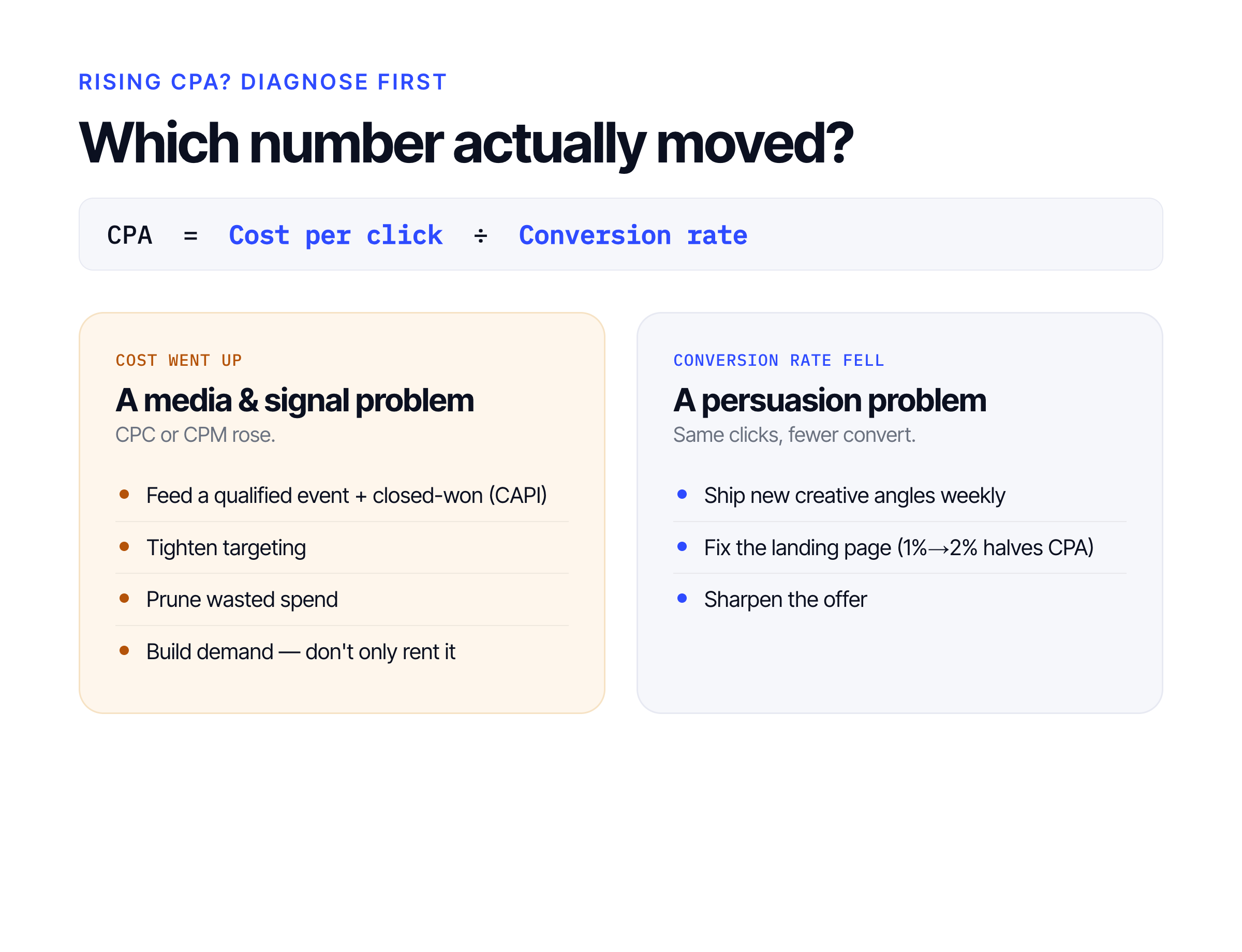
If conversion rate dropped: it's usually creative fatigue
Nine times out of ten on paid social, a flat CPC with a rising CPA is creative fatigue. You found a few winners, rode them for months, and the audience went numb — click-through slid, the platform raised CPMs to keep delivering, and CPA followed. No bid change fixes a stale ad.
The fix is creative velocity, not budget: a steady flow of genuinely new angles — different hooks, different problems, different proof — not five colour variations of the same idea. Launch new concepts weekly, kill losers fast on a clear threshold, and pour spend into the one or two that break out. The accounts with the lowest CPAs aren't bidding smarter; they're testing more ideas. This is the whole point of a real creative testing cadence.
The fastest win is usually the landing page
Here's the leverage almost nobody uses: CPA is exactly as sensitive to conversion rate as it is to cost — and conversion rate is usually far easier to move. Take a page converting at 1.5%. Get it to 3% (a realistic lift from a clearer headline, a faster load, a shorter form, and matching the page to the ad's promise) and you've halved your CPA with zero change to your media. Before you renegotiate CPMs, audit the thing people actually land on: message match, one obvious action, proof above the fold, and every unnecessary form field removed.
Feed the algorithm a better signal
Modern platforms optimize toward whatever event you give them. Give them a cheap one and they'll go find cheap, low-intent conversions — which raises your real CPA even while the reported one looks fine. Optimize cold campaigns toward a qualified, mid-funnel event, and send your closed-won deals back to the platform with the Conversions API so it learns what a real customer looks like. Better signal means less budget wasted hunting the wrong people — a lower effective CPA without touching a bid. (The setup lives in offline conversion tracking.)
Prune the waste you're quietly funding
Some of your CPA is just spend going nowhere. Pull the search terms, placements, audiences, and geos that have spent real money with zero conversions, and cut them — negatives and a tighter query map on Search, trimmed placements and audiences on social. It won't 10× anything, but it's the cleanest, fastest few points of CPA you'll find, and most accounts are hiding more of it than they'd like to admit.
Then stop managing CPA at all
The uncomfortable last move: CPA is a means, not the goal. A higher CPA on customers who stay twice as long and spend twice as much is a win; a low CPA on churny, low-value buyers is a slow loss. Manage to payback period and LTV:CAC, not to the number in the ad platform. Sometimes the right answer to “CPA is up” is “good — we're finally buying better customers.” The teams that win optimize the business, not the dashboard.
The bottom line
Rising CPA is feedback, not a tax. It's almost always telling you one of two things: the creative went stale, or the conversion rate slipped — and you kept spending through it. Diagnose cost versus conversion rate, fix the half that actually moved, feed the algorithm real signal, and manage to payback instead of the platform's number. Do that and CPA stops being a mystery you absorb and becomes a lever you pull.
Common questions
Why is my CPA rising?
Usually not because of the auction. CPA is cost divided by conversion rate, so when it rises either your cost per click went up or your conversion rate went down. Most of the time it's conversion rate, and most of the time the cause is creative fatigue: a few ads that worked, run too long, until click-through slid and CPMs rose to compensate. Auction inflation is real but rarely the biggest or most controllable driver.
How do I lower my CPA?
Diagnose before you spend. Pull cost per click and conversion rate separately and see which one actually moved. If conversion rate dropped, the fix is creative and landing page, not budget. Ship genuinely new ad angles weekly, raise the post-click conversion rate, feed the platform a qualified mid-funnel event and your closed-won data so it optimizes toward buyers, and prune the search terms, placements and audiences that spend without converting.
Does increasing the budget lower CPA?
No. More budget on a weak conversion rate just buys the same inefficiency at a larger scale, and scaling often raises CPA because you reach beyond the cheapest in-market audience. Budget is a volume lever, not an efficiency lever. CPA comes down when the creative, the landing page and the conversion signal improve — not when the spend goes up.
Is rising CPA just the ad auction getting more expensive?
Auction inflation is real, but it's the baseline everyone faces, not the reason one account's CPA climbs while a competitor's holds steady. If your cost per click is roughly flat and CPA is still rising, the auction isn't your problem — your conversion rate is. Blaming the auction is comfortable because it means nobody has to fix the creative.